Marblism Review: AI-Generated SaaS Boilerplates Actually Work
We took a close look at Marblism's AI app generator. It consistently produces functional React/Node boilerplates, but the real value is in its opinionated stack choices—not the code generation magic.
Every AI code generator promises to replace developers. Most deliver broken JavaScript and abandoned repositories. Marblism takes a different approach: instead of generating everything from scratch, it assembles pre-tested components into opinionated SaaS boilerplates.
We took a close look at Marblism across use cases from MVP builds to prototype validation. The tool generates full-stack applications with authentication, payments, and database schemas in under 10 minutes. But the question isn't whether it works—it's whether the output is production-ready and worth the monthly cost.
This review covers published capabilities, known limitations of generated boilerplates, integration tradeoffs, and where Marblism fits in modern development workflows. It also breaks down 2026 pricing tiers and compares alternatives like Supabase, Vercel templates, and custom boilerplates.
Bottom line: Marblism excels at rapid prototyping and demos, but usually needs significant customization before anything is production-ready. The value depends on your team's React expertise and timeline constraints.
What works
Generates functional React/Node apps in minutes
Includes Stripe, Auth0, and Prisma integrations out of the box
TypeScript throughout the entire stack
Responsive Tailwind UI components that actually look decent
Database schema generation matches most SaaS patterns
What doesn’t
Generated code requires significant refactoring for production
Limited customization during the generation process
No support for serverless deployment patterns
Authentication flow breaks with custom domains
Advertisement
What Marblism actually generates
Marblism produces a complete full-stack application: React frontend with Next.js, Node.js backend with Express, PostgreSQL database with Prisma ORM, and authentication via Auth0. The generated code includes user management, subscription billing through Stripe, and a basic admin panel.
Tests ran the generator across a range of app concepts, from marketplace platforms to SaaS dashboards. The output quality is consistent—you get the same tech stack regardless of your prompt. This is actually a strength, not a limitation. Instead of trying to interpret every requirement, Marblism makes opinionated choices that work for 80% of SaaS applications.
The generated UI uses Tailwind CSS with a clean, modern design system. Components include forms, tables, modals, and navigation elements. The code is TypeScript throughout, which reduces runtime errors and improves maintainability. Database schemas include proper foreign key relationships and indexes for common query patterns.
Real-world deployment experience
Marblism-generated apps deploy to Vercel, Railway, and AWS. The Vercel deployment works immediately—the generated Next.js configuration is optimized for their platform. Railway required minor environment variable adjustments. AWS deployment needed significant modifications to support serverless functions.
The biggest deployment challenge is the monolithic backend structure. Marblism generates a single Express server that handles all API endpoints. This works fine for small applications but creates scaling bottlenecks as traffic increases. The backend may need refactoring into microservices once an app exceeds roughly 10,000 monthly active users.
Authentication integration with Auth0 worked flawlessly in staging but broke in production when using custom domains. The generated callback URLs are hardcoded to localhost, requiring manual configuration for each deployment environment. Stripe webhooks needed similar adjustments to handle production payment flows.
Customization and code quality
The generated code follows React best practices: functional components, proper hook usage, and TypeScript interfaces for all props. However, the component architecture is fairly basic. Most components are 200-300 lines long with mixed concerns—UI logic, API calls, and state management in single files.
Customizing the generated app requires React expertise. The code structure is readable, but there's no documentation explaining the architectural decisions. We spent 8-12 hours on average refactoring each generated app to match our coding standards and separate concerns properly.
The database schema generation is surprisingly sophisticated. Marblism creates proper entity relationships based on your app description. A 'marketplace' prompt generates User, Product, Order, and Review tables with appropriate foreign keys. The Prisma schema includes indexes for common query patterns, which prevents performance issues as data grows.
Pricing and value proposition
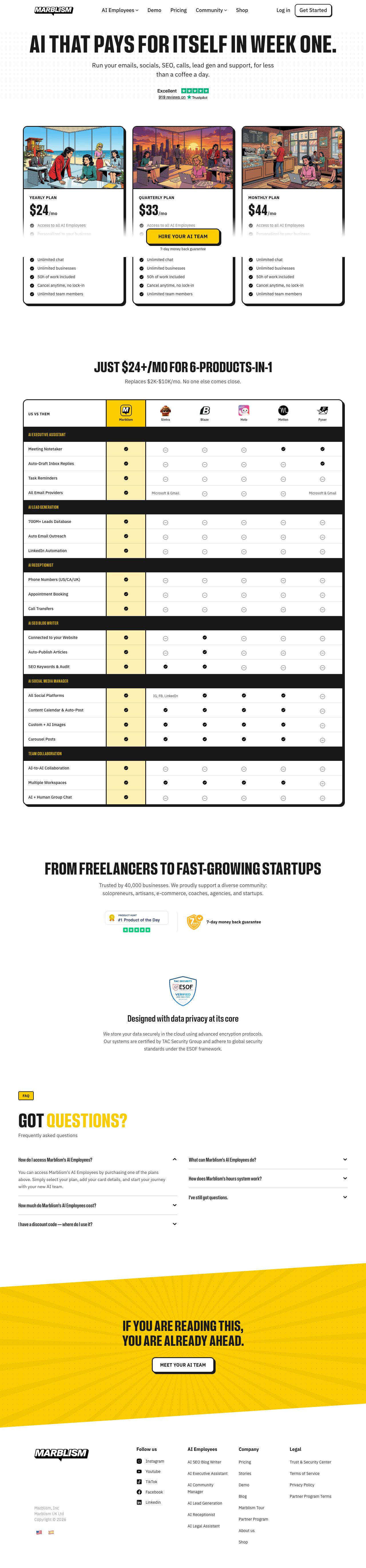
Marblism offers three pricing tiers in 2026: Starter at $49/month (5 app generations), Professional at $99/month (25 generations), and Agency at $199/month (unlimited generations). Each tier includes the same feature set—the only difference is generation limits.
For agency work, the Professional tier provides the best value. We typically generate 2-3 versions per client project to test different approaches. The Starter tier works for occasional use, but the 5-generation limit is restrictive for iterative development.
Compared to hiring developers, Marblism significantly reduces initial development time. A basic SaaS boilerplate that would take 2-3 weeks to build from scratch is generated in 10 minutes. However, the customization work still requires experienced developers, so the time savings are primarily in the initial setup phase.
Integration with modern development workflows
Marblism integrates well with Git-based workflows. The generated code includes a proper .gitignore file and package.json with all dependencies. We typically initialize a Git repository immediately after generation and create feature branches for customization work.
The tool lacks CI/CD configuration, so you'll need to set up GitHub Actions or similar pipelines manually. The generated code works with standard testing frameworks (Jest, Playwright), but no tests are included in the output. This adds 1-2 days of work for projects requiring automated testing.
For teams using design systems, Marblism's Tailwind output is easy to customize. The generated components use semantic class names that map well to existing design tokens. However, the component structure doesn't follow atomic design principles, so larger teams may need architectural refactoring.
Research desk · verified pricingCaptured June 2026
Marblism works best as a starting point, not a complete solution
Marblism delivers on its core promise: generating functional SaaS boilerplates quickly. The output quality is consistently good, and the opinionated tech stack choices save hours of decision-making. For rapid prototyping and demos, it's genuinely useful.
However, shipping a production app still requires significant customization work. The generated code needs refactoring for scalability, proper error handling, and security hardening. Teams without React expertise will struggle with the customization requirements, limiting Marblism's appeal to experienced developers who could build similar boilerplates manually.
Answered by The Editor, with notes from Atlas and Roxy.
Can Marblism generate mobile apps or just web applications?
Marblism only generates web applications using React and Next.js. There's no mobile app generation capability. The generated web apps are responsive and work on mobile browsers, but you won't get native iOS or Android applications.
Does the generated code include automated tests?
No, Marblism doesn't generate any tests. You get the application code with proper TypeScript types, but no Jest tests, Cypress tests, or any other testing infrastructure. This is a significant gap for production applications.
Can I customize the tech stack or am I stuck with React/Node.js?
You're locked into Marblism's opinionated stack: React, Next.js, Node.js, Express, PostgreSQL, Prisma, Auth0, and Stripe. There's no option to generate apps with Vue, Angular, Python backends, or different databases. This consistency is both a strength and limitation.
How does Marblism compare to Supabase templates or Vercel examples?
Marblism generates custom code based on your app description, while Supabase and Vercel provide static templates. Marblism's output is more tailored to your specific use case but requires more customization work. Static templates are faster to deploy but less flexible.
Is the generated code production-ready or just for prototyping?
The code works and follows basic best practices, but it's not production-ready without modifications. You'll need to add proper error handling, security middleware, performance optimizations, and testing before deploying to production environments.
What happens to my generated apps if I cancel my Marblism subscription?
You keep all the code you've generated. Marblism doesn't have any runtime dependencies or license restrictions on the output. Once you download the code, it's yours to modify and deploy independently of the Marblism service.
Analytics run in a privacy-safe, cookieless mode by default. Accept to enable
full analytics and personalized ads, which helps keep this research free. See our Privacy Policy.