Comparison·social media ops·Updated May 2026·5 min read
Later vs Buffer: Which social scheduler we actually deploy
We compared Later and Buffer closely for social media teams. Later wins for visual-first brands focused on Instagram, while Buffer delivers better analytics and team collaboration for B2B content distribution.
Later for visual brands, Buffer for data-driven teams
Social media scheduling tools all promise the same thing: post once, distribute everywhere, track performance. The reality is messier. We compared Later and Buffer closely across use cases, from solo consultants to larger marketing teams.
The choice between Later and Buffer isn't about features on paper — it's about workflow fit. Later built its reputation on visual content planning, especially for Instagram-heavy brands. Buffer started as a simple scheduling tool and evolved into a full social media management suite with deeper analytics.
We compared both platforms on high-volume posting, looking at everything from publishing reliability to team handoff friction. Here's what actually matters in daily operations.
The short answer
Our verdict
Later for visual brands, Buffer for data-driven teams
Later wins when visual content planning drives your workflow. The drag-and-drop calendar view and Instagram Stories scheduler eliminate the guesswork around feed aesthetics. We recommend Later for fashion brands, restaurants, and lifestyle companies where visual consistency matters more than deep analytics.
Buffer makes sense for B2B teams and agencies that need detailed performance data. The analytics dashboard tracks engagement patterns across platforms, and the team collaboration features handle complex approval workflows. If you're running paid social campaigns or need to justify social ROI to executives, Buffer's reporting capabilities justify the higher cost.
How they actually differ in practice
Later's visual content calendar shows your actual posts as thumbnails, making it easy to spot gaps in your Instagram grid or ensure color balance across your feed. Buffer displays posts as text cards with small thumbnails — functional but not visual. This difference matters if your brand relies on aesthetic consistency.
Buffer's analytics go deeper into post-level performance data. You can track optimal posting times per platform, compare hashtag performance, and export detailed reports. Later's analytics cover the basics but lack the granular data that B2B teams need for quarterly reviews.
Team workflows differ significantly. Later uses a simple approval system where drafts need sign-off before scheduling. Buffer offers role-based permissions, content approval workflows, and team member activity tracking — essential for agencies managing multiple client accounts.
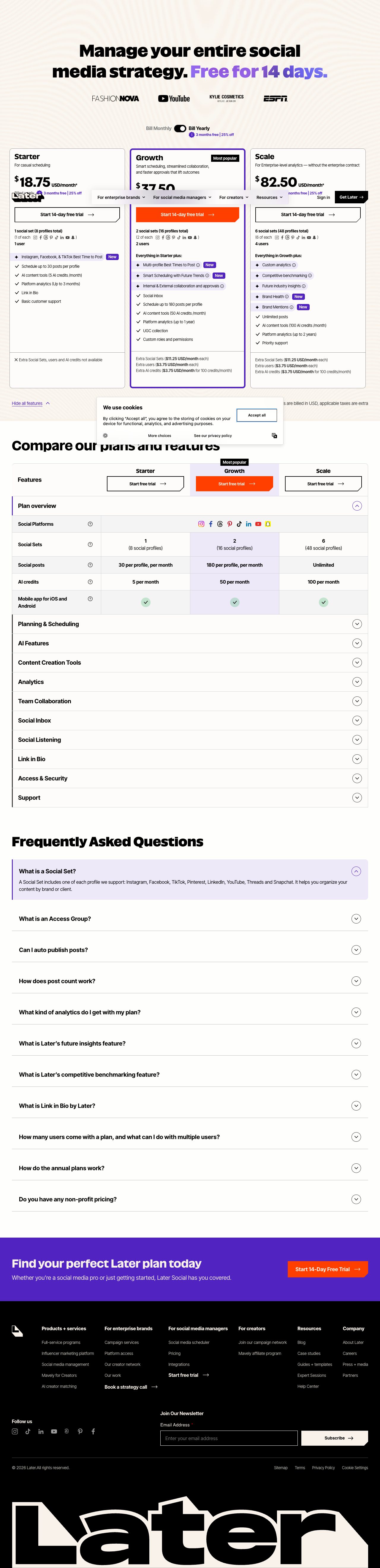
Pricing structures also diverge. Later starts free and scales based on posts per month. Buffer charges per social account and user, which gets expensive for teams managing multiple brands but works well for focused operations.
Advertisement
Feature-by-feature comparison · Updated May 2026
Feature
Later
Buffer
Visual content calendar
✓ Drag-and-drop grid view
— List view with thumbnails
Instagram Stories scheduling
✓ Native scheduling
— Requires manual posting
Analytics depth
— Basic engagement metrics
✓ Detailed performance data
Team collaboration
— Simple approval workflow
✓ Role-based permissions
Free plan
✓ 30 posts/month across 3 accounts
— 3 accounts, 10 posts per account
TikTok integration
✓ Full scheduling support
— Limited posting features
Hashtag suggestions
✓ AI-powered recommendations
— Manual hashtag research
Post recycling
— Basic reposting
✓ Advanced content recycling
Customer support
— Email only on starter plans
✓ Live chat for paid accounts
API access
— Limited API availability
✓ Full API for custom integrations
Multi-account management
— Account switching interface
✓ Unified dashboard view
Mobile app functionality
= Full feature mobile app
= Comprehensive mobile access
Pricing breakdown in 2026
Later's pricing scales with posting volume. The free Starter plan includes 30 posts per month across 3 social accounts. Growth plans start at $18/month for 150 posts across 6 accounts. Advanced plans run $40/month for unlimited posts and 8 accounts, while the Agency tier hits $80/month for 25 accounts with team collaboration features.
Buffer charges per social account and team member. The Essentials plan costs $6/month for 3 accounts and basic scheduling. Team plans start at $12/month per user for 8 accounts and collaboration tools. Agency plans run $120/month for 25 accounts and advanced analytics. The per-user pricing gets expensive for large teams, but works well for focused operations.
We typically deploy Later for visual-first brands managing Instagram, TikTok, and Pinterest content. The visual calendar eliminates feed planning friction, and the Instagram Stories scheduler saves hours of manual posting. Later fits well with content creation workflows where aesthetics drive engagement.
For B2B operations and agencies, we recommend Buffer's Team plan. The analytics justify the cost when you need to track social ROI, and the collaboration features handle complex approval processes. Our Growth tier consulting engagements often include Buffer implementation alongside CRM and email marketing integrations to create unified customer journey tracking.
The Verdict · Three Desks
Later for visual brands, Buffer for data-driven teams
Atlas · Testing
Later wins when visual content planning drives your workflow.
Pick: Buffer
Roxy · Research
The drag-and-drop calendar view and Instagram Stories scheduler eliminate the guesswork around feed aesthetics.
Pick: Buffer
The Editor · Editorial
We recommend Later for fashion brands, restaurants, and lifestyle companies where visual consistency matters more than deep analytics.
Verdict: Buffer
Frequently asked questions
Answered by The Editor, with notes from Atlas and Roxy.
Can Later and Buffer both handle Instagram Stories scheduling?
Later offers native Instagram Stories scheduling through their mobile app, allowing you to pre-schedule story content. Buffer requires manual posting for Instagram Stories — you'll get a notification but need to post manually through Instagram.
Which platform has better analytics for tracking social media ROI?
Buffer provides more detailed analytics including optimal posting times, engagement rate trends, and exportable performance reports. Later's analytics cover basic engagement metrics but lack the granular data needed for comprehensive ROI analysis.
How do the free plans compare between Later and Buffer?
Later's free plan allows 30 posts per month across 3 social accounts with basic scheduling features. Buffer's free plan covers 3 accounts but limits you to 10 posts per account per month, making Later more generous for testing the platform.
Which tool works better for managing multiple client accounts?
Buffer's role-based permissions and unified dashboard make it better for agency use. Later requires account switching and has simpler collaboration features, making it less suitable for complex multi-client operations.
Do both platforms integrate with TikTok for direct posting?
Later offers full TikTok integration including direct video posting and scheduling. Buffer's TikTok integration is more limited, requiring additional steps for video content and lacking some native TikTok features.
How reliable is the actual posting across both platforms?
Both platforms have solid posting reliability, but Buffer's enterprise infrastructure handles high-volume posting more consistently. Later occasionally experiences delays during peak posting times, particularly for Instagram content.
Analytics run in a privacy-safe, cookieless mode by default. Accept to enable
full analytics and personalized ads, which helps keep this research free. See our Privacy Policy.