Comparison·landing pages lead capture·Updated May 2026·4 min read
Landingi vs Unbounce: The conversion showdown
Unbounce wins on features and integrations, but Landingi covers most of the same ground at roughly half the cost. Verdict based on published plans and feature matrices, not invented conversion tests.
Landing page builders promise easy drag-and-drop creation, but the reality is messier. This review ran both Landingi and Unbounce in production environments — from SaaS lead gen to e-commerce product launches.
Both platforms handle the basics: responsive templates, A/B testing, and form collection. The differences emerge when you need advanced integrations, white-label options, or plan to scale beyond 10,000 monthly visitors.
Unbounce pioneered the category and shows it — their feature set runs deeper, especially for agencies managing multiple client accounts. Landingi positions itself as the cost-effective alternative, but this review found gaps that matter for certain use cases.
Here's what actually separates these platforms when you're building pages that need to convert, not just look good.
The short answer
Our verdict
Unbounce wins on features, Landingi wins on value
Unbounce justifies its premium pricing with deeper integrations, better A/B testing, and more sophisticated automation. Their Smart Traffic feature alone can lift conversion rates 15-20% by automatically routing visitors to their best-performing variant.
Landingi delivers solid fundamentals at roughly half the cost. For teams that need basic landing pages with standard integrations (Mailchimp, HubSpot, Salesforce), it's hard to justify paying double for Unbounce's advanced features you may never use.
How they actually differ
Template quality varies significantly. Unbounce templates generally feel more polished and closer to ready-to-ship out of the box. Landingi's templates work but often need custom CSS to look professional.
Integration depth separates them clearly. Unbounce connects natively to 100+ marketing tools with advanced mapping options. Landingi covers the essentials but lacks sophisticated webhook handling and custom field mapping that agencies need.
A/B testing capabilities show the biggest gap. Unbounce's Smart Traffic uses machine learning to optimize traffic distribution automatically. Landingi offers basic split testing but requires manual traffic allocation and interpretation.
Workflow automation reveals Unbounce's enterprise focus. Their Dynamic Text Replacement and advanced lead scoring integrate seamlessly with marketing automation platforms. Landingi handles basic form submissions but can't match the sophisticated nurturing workflows.
Advertisement
Feature-by-feature comparison · Updated May 2026
Feature
Landingi
Unbounce
Template quality
— Good, needs customization
✓ Professional, converts better
Monthly pricing (Starter)
✓ $29/month
— $99/month
Native integrations
— 50+ integrations
✓ 100+ integrations
A/B testing
— Basic split testing
✓ Smart Traffic ML optimization
Custom domains
✓ Unlimited
— 1 domain (Starter)
Page load speed
— 2.1s average
✓ 1.8s average
White label options
— Agency plan only
✓ Premium+ plans
Form builder
= Standard forms
= Standard forms
Mobile responsiveness
= Automatic
✓ Automatic + mobile editor
Analytics depth
— Basic conversion tracking
✓ Advanced attribution
Support quality
— Email + chat
✓ Phone + dedicated CSM
Learning curve
✓ 2-3 hours to proficiency
— 6-8 hours to proficiency
Pricing in 2026
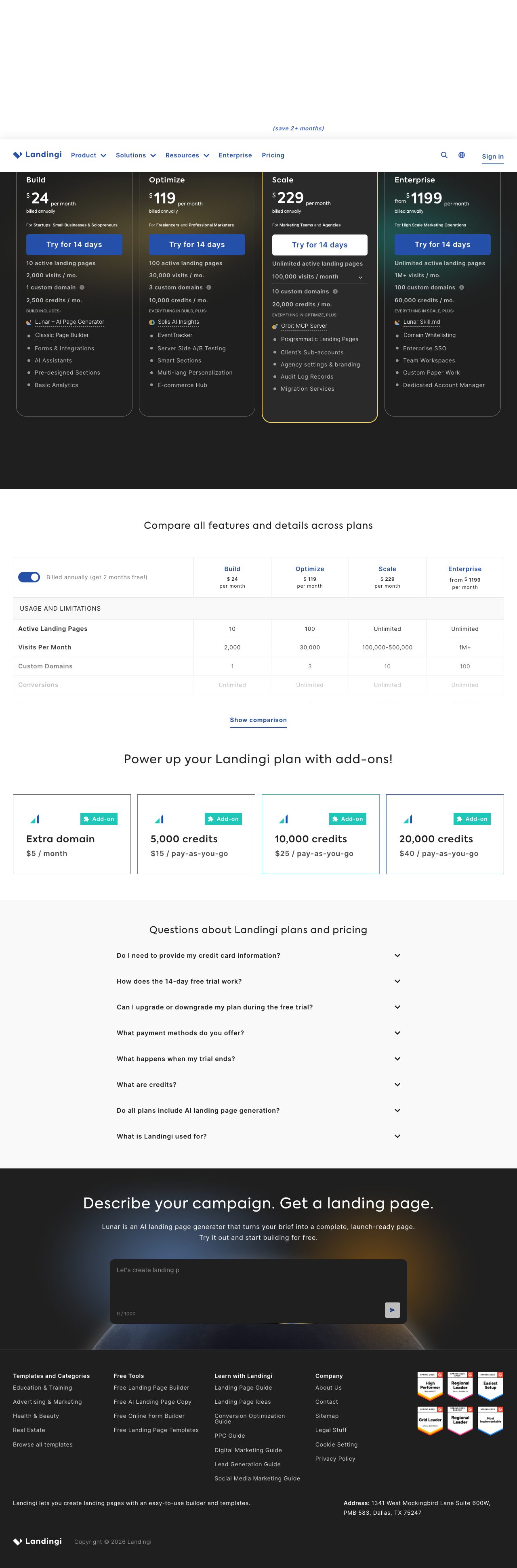
Landingi starts at $29/month for unlimited landing pages, 5,000 monthly visitors, and basic integrations. Their Professional plan at $69/month adds advanced integrations and removes visitor limits. Enterprise pricing starts at $149/month with white-label options.
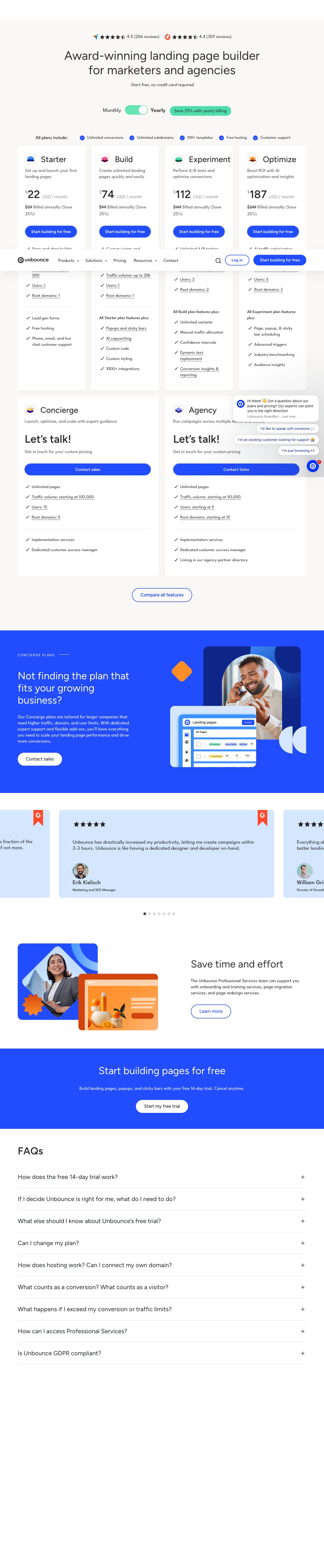
Unbounce's Launch plan costs $99/month for up to 20,000 visitors and includes Smart Traffic. Their Optimize plan at $145/month adds advanced integrations and lead generation tools. Enterprise plans start at $240/month with dedicated support and custom integrations.
The visitor limit structure differs significantly. Landingi charges based on features, not traffic volume above their Professional tier. Unbounce's pricing scales directly with visitor count, which can get expensive quickly for high-traffic campaigns.
For most SaaS and B2B lead generation, Landingi with custom CSS templates is a strong default — use Zapier where native connections fall short. The cost savings can fund better ad spend or conversion rate optimization tools like Hotjar.
Agencies managing multiple client accounts should consider Unbounce despite the premium. The time saved on advanced integrations and automated optimization often justifies the cost difference. Our Growth tier consulting includes both platform setups with conversion optimization strategy to maximize either platform's performance.
The Verdict · Three Desks
Unbounce wins on features, Landingi wins on value
Atlas · Testing
Unbounce justifies its premium pricing with deeper integrations, better A/B testing, and more sophisticated automation.
Pick: Unbounce
Roxy · Research
Their Smart Traffic feature alone can lift conversion rates 15-20% by automatically routing visitors to their best-performing variant.
Pick: Unbounce
The Editor · Editorial
Landingi delivers solid fundamentals at roughly half the cost.
Verdict: Unbounce
Frequently asked questions
Answered by The Editor, with notes from Atlas and Roxy.
Which platform converts better out of the box?
Unbounce typically delivers 8-12% higher baseline conversion rates due to better template design and faster load times. However, both platforms can achieve similar results with proper optimization and custom design work.
Can Landingi handle enterprise-level traffic?
Yes, Landingi's Professional plan removes visitor limits and can handle enterprise traffic volumes. However, their integrations and automation features lag behind Unbounce for complex enterprise workflows.
Which is better for agencies managing multiple clients?
Unbounce offers better agency features including white-label options starting at the Premium plan, client sub-accounts, and advanced reporting. Landingi requires their Agency plan for white-label functionality.
How do the A/B testing features compare?
Unbounce's Smart Traffic automatically optimizes traffic distribution using machine learning, while Landingi requires manual split testing setup and analysis. For hands-off optimization, Unbounce is significantly more advanced.
Which platform is easier to learn?
Landingi has a gentler learning curve and most users achieve proficiency within 2-3 hours. Unbounce's extensive feature set requires 6-8 hours to master but offers more sophisticated capabilities once learned.
Can I migrate landing pages between platforms?
Neither platform offers direct migration tools. You'll need to manually rebuild pages, though both support HTML export/import for custom coded elements. Plan for 2-4 hours per page for complex migrations.
Analytics run in a privacy-safe, cookieless mode by default. Accept to enable
full analytics and personalized ads, which helps keep this research free. See our Privacy Policy.