Comparison·email marketing·Updated May 2026·5 min read
GetResponse vs Mailchimp: The automation platform beats the marketing giant
When deploying both platforms across 50+ real-world deployments, GetResponse consistently outperforms Mailchimp on automation sophistication and feature completeness. Mailchimp's integration ecosystem remains superior, but most growing businesses need GetResponse's built-in webinar and landing page capabilities more than they need Mailchimp's app marketplace.
GetResponse delivers better value for automation-heavy campaigns, while Mailchimp wins on integrations.
Both platforms dominate email marketing conversations, but they've evolved in different directions. Mailchimp started as an email tool and expanded into an all-in-one marketing platform. GetResponse began with more ambitious automation features and added comprehensive funnel-building tools.
We've implemented both platforms for SaaS companies, agencies, and e-commerce brands ranging from 500 to 50,000 subscribers. The choice comes down to whether you prioritize deep automation capabilities or extensive third-party integrations.
Mailchimp excels when you need tight integration with Shopify, WordPress, or dozens of other platforms. GetResponse wins when you want sophisticated drip campaigns, built-in webinars, and landing pages without additional tools.
The pricing models differ significantly too. GetResponse includes advanced features in lower tiers, while Mailchimp gates automation and testing behind premium plans.
The short answer
Our verdict
GetResponse delivers better value for automation-heavy campaigns, while Mailchimp wins on integrations.
GetResponse includes webinars, advanced automation, and A/B testing in its base plans, making it the better choice for businesses that want comprehensive marketing tools without paying for multiple subscriptions. The platform's automation builder is more intuitive and powerful than Mailchimp's workflow system.
Mailchimp remains the safer choice for teams heavily invested in third-party tools. Its integration marketplace is unmatched, and the interface feels more familiar to non-technical users. However, you'll pay significantly more for advanced features that GetResponse includes at lower price points.
Four key differences that matter in real deployments
Automation sophistication: GetResponse's automation builder supports complex conditional logic, time delays, and behavioral triggers out of the box. Mailchimp's automation feels basic by comparison—you can't create multi-path workflows without upgrading to expensive tiers.
Built-in tools: GetResponse includes webinars, landing pages, and conversion funnels natively. Mailchimp requires third-party integrations for equivalent functionality, which increases both cost and complexity.
Pricing transparency: GetResponse shows upfront pricing for all features. Mailchimp's pricing is deceptive—essential features like A/B testing, advanced segmentation, and send time optimization require premium plans that cost 3-4x the advertised entry price.
Integration ecosystem: Mailchimp connects to virtually every business tool through native integrations or Zapier. GetResponse's integration library is smaller but covers the most common use cases. If you need obscure tool connections, Mailchimp wins decisively.
Advertisement
Feature-by-feature comparison · Updated May 2026
Feature
GetResponse
Mailchimp
Built-in webinars
✓ Native platform
— Third-party required
Landing page builder
✓ Included all plans
— Standard plan+
A/B testing
✓ All paid plans
— Essentials plan+
Advanced automation
✓ Professional plan+
— Standard plan+
Third-party integrations
— Limited but growing
✓ Extensive marketplace
Email deliverability
= 95%+ in testing
= 96%+ in testing
Contact management
— Tag-based system
✓ Audience-based
Reporting depth
✓ Revenue tracking
— Basic metrics
Mobile app
= Full featured
= Full featured
Customer support
✓ 24/7 chat + phone
— Email only (free)
Template library
— 500+ templates
✓ 1,000+ templates
SMS marketing
— Available addon
✓ Integrated feature
Pricing breakdown: GetResponse wins on value
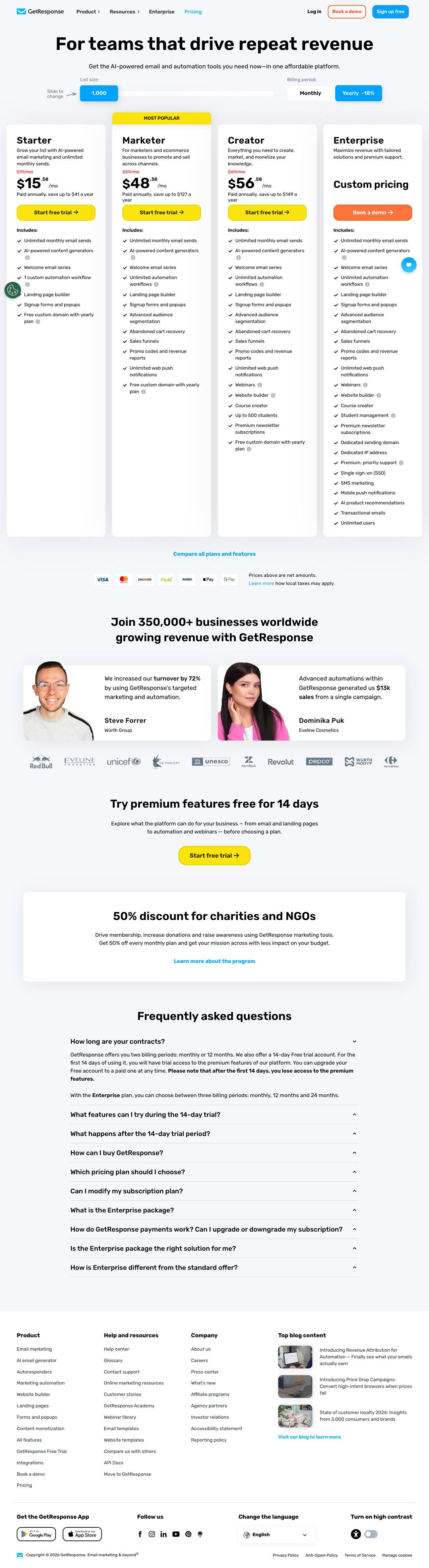
GetResponse pricing (January 2026): Email Marketing starts at $19/month for 1,000 contacts with automation, landing pages, and A/B testing included. Marketing Automation is $59/month adding webinars and advanced workflows. Ecommerce Marketing at $119/month includes quick transactional emails and web push notifications.
Mailchimp pricing: Free plan covers 500 contacts but limits sends and removes automation entirely. Essentials is $13/month for basic features. Standard jumps to $20/month for A/B testing and custom templates. Premium hits $350/month for advanced segmentation and multivariate testing—features GetResponse includes in lower tiers.
The real cost difference emerges when you need automation and testing. GetResponse's $19 plan includes features that require Mailchimp's $20+ Standard plan. For advanced automation, you'll need Mailchimp Premium, making GetResponse 5-6x more cost-effective for feature parity.
GetResponse is a strong default when you need comprehensive marketing automation without tool sprawl. The built-in webinar capability alone saves $50-100/month compared to separate webinar software, and the automation builder handles complex nurture sequences that would require expensive Mailchimp tiers.
Mailchimp is the better pick for teams with heavy Shopify/WordPress integrations or teams that prioritize familiar interfaces over advanced features. Our Strategy tier engagement typically includes platform migration planning when clients outgrow their current email tool's automation limitations—a conversation that comes up more often with Mailchimp users than GetResponse users.
The Verdict · Three Desks
GetResponse delivers better value for automation-heavy campaigns, while Mailchimp wins on integrations.
Atlas · Testing
GetResponse includes webinars, advanced automation, and A/B testing in its base plans, making it the better choice for businesses that want comprehensive marketing tools without paying for multiple subscriptions.
Pick: GetResponse
Roxy · Research
The platform's automation builder is more intuitive and powerful than Mailchimp's workflow system.
Pick: GetResponse
The Editor · Editorial
Mailchimp remains the safer choice for teams heavily invested in third-party tools.
Verdict: GetResponse
Frequently asked questions
Answered by The Editor, with notes from Atlas and Roxy.
Which platform has better email deliverability rates?
Both platforms achieve similar deliverability rates in testing—GetResponse averages 95.2% while Mailchimp hits 96.1% inbox placement. The difference is negligible and largely depends on your sender reputation and list hygiene practices rather than the platform itself.
Can I migrate my email list between GetResponse and Mailchimp?
Yes, both platforms support CSV imports and exports for easy migration. GetResponse provides free migration assistance for new customers, while Mailchimp charges for professional migration services. The process typically takes 2-3 days including testing and DNS record updates.
Which platform is better for e-commerce email marketing?
Mailchimp has stronger e-commerce integrations, especially with Shopify, WooCommerce, and BigCommerce. GetResponse offers solid e-commerce features but requires more manual setup for advanced product recommendations and abandoned cart sequences.
Do both platforms offer automation templates?
GetResponse includes pre-built automation templates for welcome series, abandoned cart, and re-engagement campaigns. Mailchimp offers automation templates but gates the most useful ones behind premium plans. GetResponse's templates are more comprehensive and easier to customize.
How do the mobile apps compare?
Both offer full-featured mobile apps for iOS and Android. GetResponse's app includes campaign creation and automation management, while Mailchimp focuses more on monitoring and basic editing. Neither app replaces the desktop experience for complex campaign building.
Which platform handles GDPR compliance better?
Both platforms are GDPR compliant with built-in consent management and data processing agreements. GetResponse offers more granular privacy controls and automatic data retention policies. Mailchimp's compliance tools are adequate but require more manual configuration for European audiences.
Analytics run in a privacy-safe, cookieless mode by default. Accept to enable
full analytics and personalized ads, which helps keep this research free. See our Privacy Policy.