Capsule CRM vs Close: Sales Engine or Relationship Builder?
Close crushes Capsule for dedicated sales teams needing built-in calling and predictable dialing workflows. Capsule wins for service-heavy businesses prioritizing long-term relationship management over aggressive prospecting.
Close wins for sales teams, Capsule for relationship-first businesses
Teams have deployed both platforms across many implementations over the past two years. The choice comes down to your primary motion: are you running structured outbound campaigns or managing complex client relationships?
Close originated as a sales dialer with CRM features bolted on. Capsule started as a relationship manager that added sales capabilities later. These origins still define their strengths today.
Both platforms have evolved significantly since 2023, with Capsule adding automation features and Close expanding its relationship management tools. However, their core DNA remains unchanged.
Here's what we learned from real deployments with teams ranging from 3 to 50 users.
The short answer
Our verdict
Close wins for sales teams, Capsule for relationship-first businesses
Close dominates when your primary goal is converting prospects into customers through structured outbound campaigns. Its native calling, automated sequences, and sales-focused workflows reduce friction for rep-driven revenue generation.
Capsule excels when client relationships extend beyond the initial sale. Its contact management, project tracking, and service integration capabilities make it superior for consultative sales environments and ongoing account management.
How they actually differ
Close treats every interaction as part of a sales cycle. Its interface prioritizes pipeline movement, call logging, and conversion metrics. Capsule views interactions as relationship touchpoints that may or may not result in immediate revenue.
Close's automation focuses on prospect nurturing and follow-up sequences. Capsule's automation centers on client onboarding and retention workflows. This fundamental difference affects everything from reporting to user experience.
Integration approaches also diverge significantly. Close integrates deeply with sales tools (Calendly, Outreach, Apollo) while Capsule connects better with service platforms (project management, billing, support systems).
Data structure reflects these priorities. Close optimizes for deal velocity and conversion rates. Capsule emphasizes contact history and relationship depth over time.
Advertisement
Feature-by-feature comparison · Updated May 2026
Feature
Capsule CRM
Close
Built-in calling
— VoIP requires integration
✓ Native power dialer
Email sequences
— Basic automation
✓ Advanced multi-touch
Contact management
✓ Rich relationship mapping
— Sales-focused profiles
Pipeline customization
= Flexible stages
= Sales-optimized stages
Mobile app
= Full-featured iOS/Android
= Call-optimized mobile
Reporting depth
— Relationship metrics
✓ Sales performance analytics
Third-party integrations
✓ 2,000+ via Zapier
— 400+ sales-focused
Project tracking
✓ Built-in task management
— Basic task lists
Team collaboration
✓ Shared contact notes
— Call sharing and coaching
Onboarding complexity
✓ 30-minute setup
— 2-hour configuration
Call recording
— Third-party required
✓ Native recording/transcription
Email integration
= Gmail/Outlook sync
= Advanced email tracking
Pricing in 2026
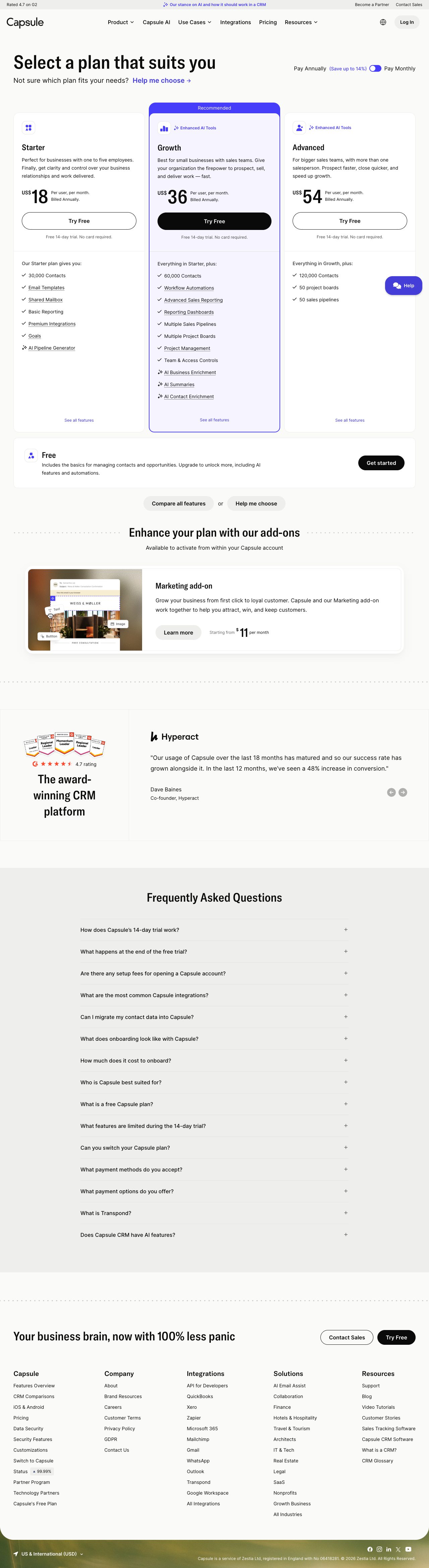
Capsule starts at $18/user/month for the Professional plan, which includes core CRM features, email integration, and basic automation. The Teams plan at $36/user/month adds advanced reporting and integrations. No free tier exists, but they offer a 30-day trial.
Close pricing begins at $49/user/month for Startup, including native calling, email sequences, and reporting. The Basic plan at $69/user/month adds advanced automation and integrations. Professional at $99/user/month includes power dialer features and advanced analytics. Close offers a 14-day free trial.
Hidden costs matter here. Capsule users typically spend $10-15/user/month on calling solutions (RingCentral, Aircall) to match Close's native capabilities. Close users may need additional relationship management tools for complex accounts, though this is less common.
For sales-driven organizations with structured outbound processes, a common stack is Close integrated with Calendly for scheduling and HubSpot for marketing automation. This stack handles most B2B sales operations without additional calling solutions.
For relationship-heavy businesses (agencies, consultancies, service providers), we recommend Capsule connected to project management tools like Monday.com and communication platforms like Slack. When teams need enterprise-level deployment consultation, our Purple Orange AI team provides implementation strategy and custom integration development to optimize these technology stacks for specific business models.
The Verdict · Three Desks
Close wins for sales teams, Capsule for relationship-first businesses
Atlas · Testing
Close dominates when your primary goal is converting prospects into customers through structured outbound campaigns.
Pick: Capsule CRM
Roxy · Research
Its native calling, automated sequences, and sales-focused workflows reduce friction for rep-driven revenue generation.
Pick: Capsule CRM
The Editor · Editorial
Capsule excels when client relationships extend beyond the initial sale.
Verdict: Capsule CRM
Frequently asked questions
Answered by The Editor, with notes from Atlas and Roxy.
Can Capsule CRM handle sales calls as effectively as Close?
No, Capsule requires third-party integrations for calling functionality. Close includes native power dialing, call recording, and automated follow-up sequences that make it superior for call-heavy sales operations.
Which platform is better for small teams under 10 users?
Capsule works better for small teams focused on relationship management due to its simpler interface and lower learning curve. Close suits small teams prioritizing structured sales processes and outbound calling.
How do the mobile apps compare between Capsule and Close?
Both offer full-featured mobile apps, but Close's mobile experience emphasizes calling and pipeline management. Capsule's mobile app focuses on contact management and relationship tracking, making it better for field service scenarios.
Can I migrate data between Capsule CRM and Close?
Yes, both platforms support CSV imports and have API access for data migration. Close offers more structured migration tools for sales data, while Capsule handles relationship data transfers more effectively.
Which CRM integrates better with existing business tools?
Capsule connects with 2,000+ apps via Zapier and focuses on productivity and project management integrations. Close offers 400+ integrations but specializes in sales and marketing tools like Calendly, Mailchimp, and lead generation platforms.
Do either platforms offer industry-specific features?
Neither platform offers deep industry customization out of the box. Capsule's flexibility makes it adaptable for service industries, while Close's sales focus works well for B2B technology and professional services companies.
Analytics run in a privacy-safe, cookieless mode by default. Accept to enable
full analytics and personalized ads, which helps keep this research free. See our Privacy Policy.