Review·b2b sales stack·Updated July 2026·4 min read
Apollo.io in 2026: The outbound database that scales
Apollo.io combines B2B contact data, enrichment, sequences, calling, workflow automation, and deal tools. We use a paid Apollo account in our own outbound work; the strongest value remains the database-plus-sequencing workflow, while credits and data verification require active management.
Apollo.io sits at the center of many outbound stacks, including ours. It combines contact discovery, enrichment, email sequences, calling tasks, workflow automation, and integrations in one platform.
We use Apollo day to day and revisited the current product and pricing surface for this review. The practical value is the ability to move from prospect research into a sequence without exporting data through several tools.
The tradeoff is governance. Contact data still needs spot checks, email sending still needs authenticated and warmed domains, and Apollo's evolving credit model can affect cost and workflow limits.
This review separates our observed workflow experience from vendor-published plan and feature information, and compares Apollo with Seamless.AI where teams commonly evaluate both.
What works
Broad B2B contact database with in-product verification
CRM integrations and enrichment workflows
Multi-channel sequence and task automation
Free plan and trial path for evaluation
Built-in email deliverability monitoring
What doesn’t
Mobile coverage varies by market and segment
Plan and credit costs require usage modeling
Credit and export limits need active monitoring
Complex CRM requirements may need a dedicated platform
Advertisement
Contact Database Quality
Apollo's contact database remains the center of the product. Email verification and enrichment sit inside prospect search, which makes it easier to inspect a record before adding it to a list or sequence.
In our use, coverage and freshness vary by segment. Email records are generally more dependable than mobile numbers, but no contact should be treated as verified solely because it appears in a database.
Evaluate Apollo with a representative sample of target accounts, job functions, geographies, and company sizes. A small accuracy audit is more useful than a platform-wide percentage that may not match your market.
Outbound Sequence Features
Apollo's sequence builder combines automated email with phone and LinkedIn tasks, rules, schedules, and account-level workflow controls. In our use, keeping prospect research and outreach in the same product is more valuable than any single sequence feature.
Apollo also publishes AI-assisted writing and deliverability tooling. We still use deliberate, human-reviewed copy for high-value outreach and treat sending-domain setup, list quality, throttling, and reply handling as operational responsibilities rather than platform guarantees.
Teams should prototype their required personalization fields, conditional paths, approvals, task steps, and CRM logging. Sequence depth and governance vary by plan, so the intended workflow should be checked against the live account rather than an old feature table.
CRM Integration Reality
Apollo publishes integrations with Salesforce, HubSpot, Outreach, Salesloft, Marketo, SendGrid, LinkedIn, and major email providers. In our own workflow, the integration value comes from keeping prospect research and sequence activity close to the sales record.
Do not assume a connector logo guarantees the required sync. Validate field mapping, deduplication, ownership, update direction, failure handling, and activity logging with the team's CRM.
API and export access vary by plan and credit system. High-volume teams should confirm current limits in their account or quote before designing a bulk workflow.
Pricing Structure 2026
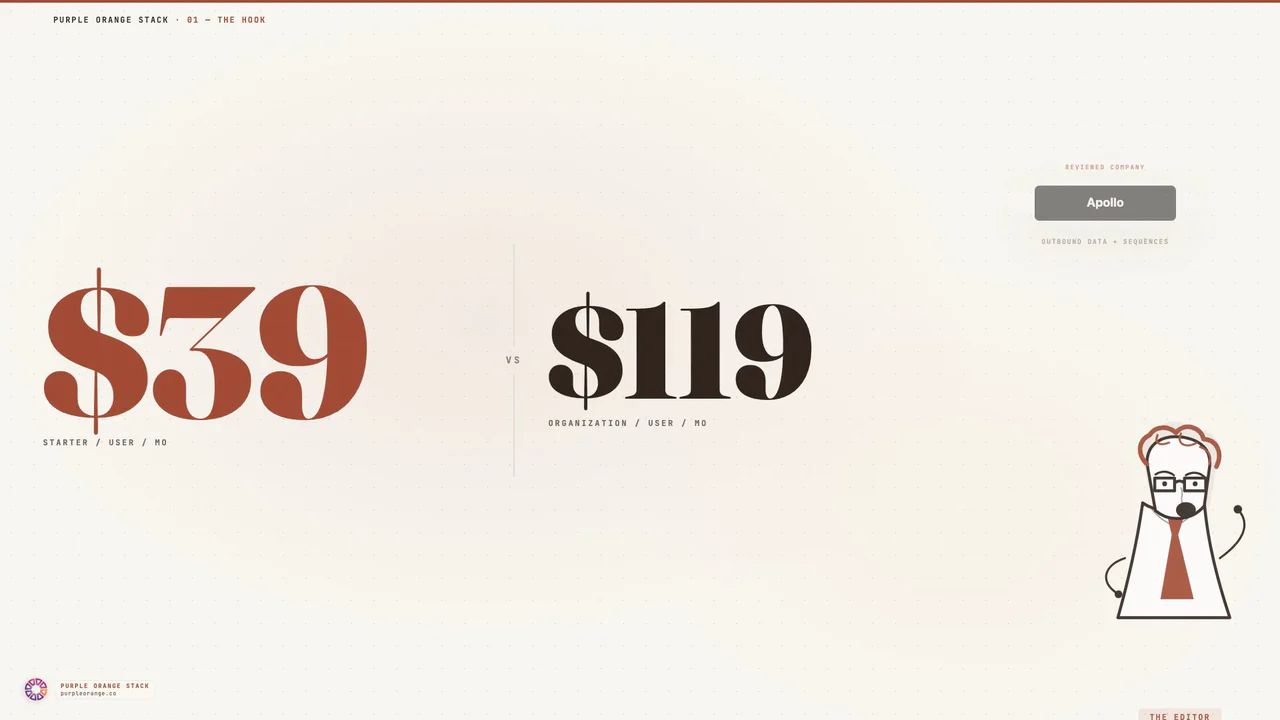
Apollo's public pricing surface now centers on plan access plus credits, and the company notes that some existing customers may still be on a legacy credit system. Trial plans include a limited credit allowance, while the free Starter path remains available after a trial.
Cost depends on seats, data and export credits, mobile numbers, enrichment, integrations, and the sequence or governance features the team needs. That makes a live account quote more reliable than an old plan-price table.
Before upgrading, model one month of realistic prospecting: searches, saved records, exports, verified emails, mobile data, enrichment, and sequence volume. Confirm rollover and fair-use rules inside the account.
Competitive Position vs Seamless.AI
Apollo and Seamless.AI should be compared with the same target-account sample and the same required workflow. Headline pricing alone does not capture data credits, exports, mobile records, verification, integrations, or sequencing.
Apollo's broader sequence and workflow surface is the main reason to prefer it when the team wants prospect data and engagement in one product. A team that only needs occasional contact discovery may not value that extra surface.
Run a side-by-side audit for match rate, valid emails, usable mobile numbers, duplicate handling, CRM sync, and total credits consumed. The winner can change by market.
Research desk · verified pricingCaptured June 2026
Apollo.io remains our preferred starting point for a structured outbound workflow because it combines prospect data, enrichment, sequences, calling tasks, and integrations in one product. That recommendation is based on our paid day-to-day use, not a universal accuracy claim.
Teams should still audit data against their own market, verify CRM behavior, and model the current credit system before committing. Apollo is strongest when the integrated workflow matters; it is easier to overbuy when the real need is only occasional contact research.
Answered by The Editor, with notes from Atlas and Roxy.
Is Apollo.io worth it compared to free alternatives like Hunter.io?
Apollo adds a broader contact database, enrichment, sequencing, calling, and workflow tools around email discovery. Hunter can be enough for occasional domain-based email research; Apollo makes more sense when the team needs an integrated outbound workflow.
How accurate are Apollo's mobile phone numbers in 2026?
There is no single accuracy rate that applies to every market or record. In our use, mobile coverage is less consistent than email data, so phone-heavy teams should validate a sample from their actual geography and buyer segment before purchasing credits.
Can Apollo.io replace Salesforce for small sales teams?
Apollo includes deal and workflow tools, but teams with complex opportunity management, permissions, forecasting, or reporting should validate those requirements against a dedicated CRM. Its strongest fit remains prospecting and sales engagement.
Does Apollo integrate well with other sales tools?
Apollo publishes integrations with Salesforce, HubSpot, Pipedrive, and other sales tools, plus API access. Validate field mapping, deduplication, update direction, activity logging, plan access, and rate limits with the team's real workflow.
What's the biggest limitation of Apollo.io?
Coverage and freshness vary by market, especially for mobile numbers, while credits and export limits can make cost harder to predict. Test a representative sample and model the current credit system before buying.
How does Apollo's pricing compare to competitors in 2026?
Apollo's current pricing uses plan access plus credits, and some accounts may be on different credit systems. Compare the live quote for the required seats, exports, mobile data, enrichment, integrations, and sequence features rather than relying on an old per-seat snapshot.
Analytics run in a privacy-safe, cookieless mode by default. Accept to enable
full analytics and personalized ads, which helps keep this research free. See our Privacy Policy.